NOVEL NONLINEAR OPTICS METHODS OF FREQUENCY CONVERSION AND NOISE SUPPRESSION
Applications of laser light, such as spectroscopy, sensing, and imaging, require laser sources at different frequencies and with different properties, such as power, bandwidth, pulse duration, etc.
Across many spectral ranges, light produced by direct laser action is not available or does not have the properties needed for certain applications. A case in point is the deep ultraviolet frequency comb laser light
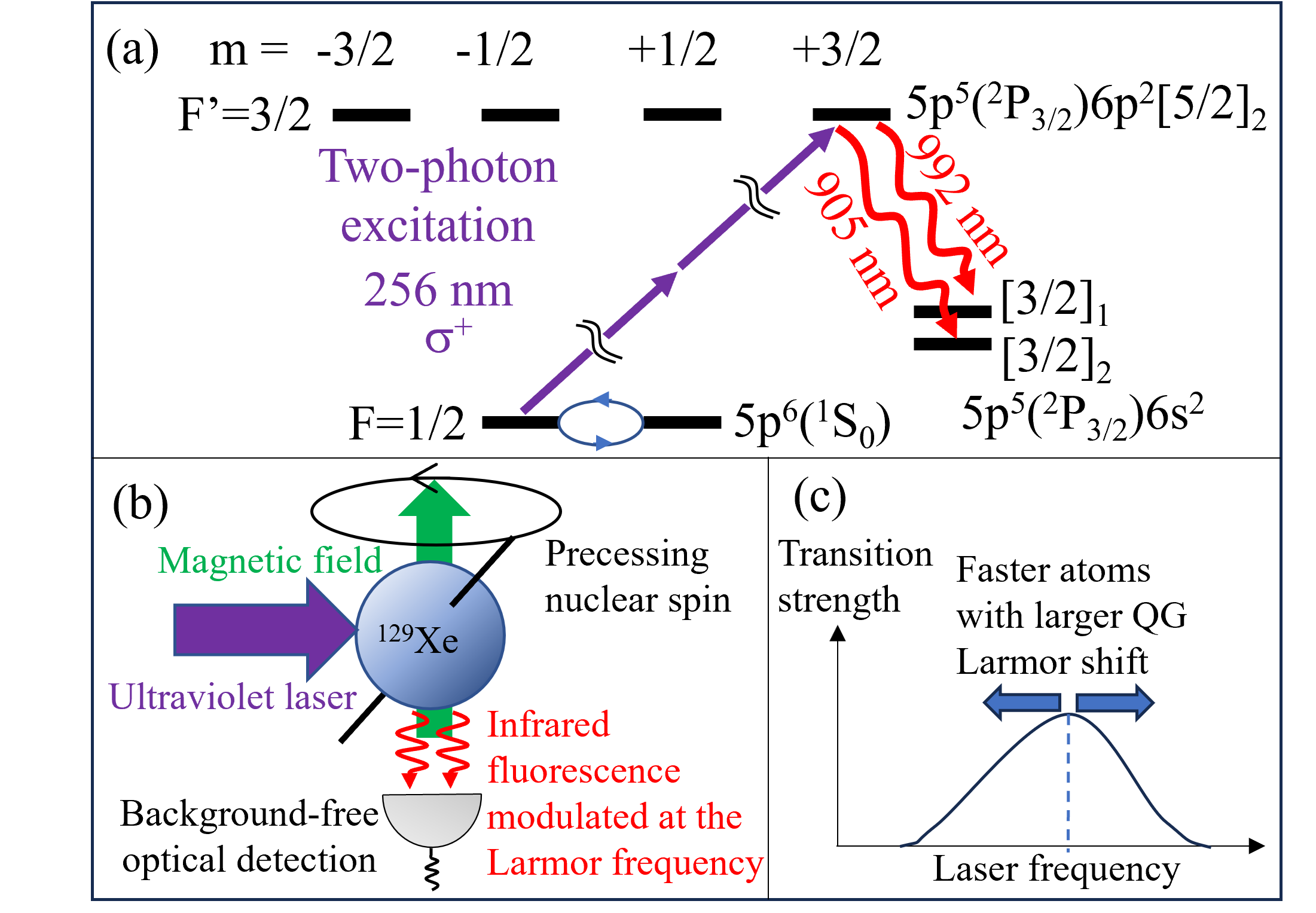
needed for the noble gas spectroscopy and quantum magnetic sensor that we are developing (see above). We are developing nonlinear optics methods for efficient frequency conversion that transfers the excellecent properties
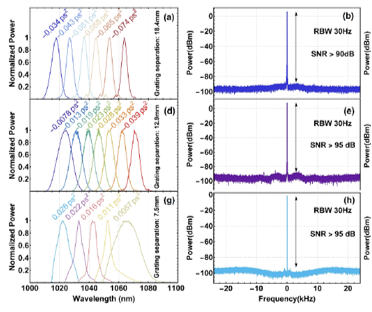
of mature laser sources (mostly in the near-infrared) to other frequency regimes, particularly deep ultravilolet and THz. Particularly, we utilize adiabatic frequency conversion to achieve efficient and
broadband frequency conversion. This approach is based on using slow spatial variation along a medium that interacts with laser light, rather than a medium with fixed or periodically-alternating properties.
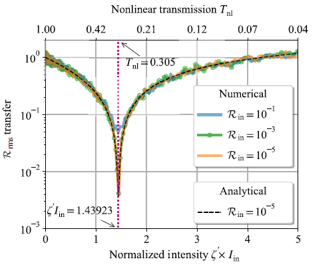
Adiabatic nonlinear optics defeats long-standing trade-offs between efficiency and robustness. We are also developing nonlinear optical methods for suppressing laser noise and pulse-to-pulse energy fluctuations,
as noise reduction directly translates to improved perfomance in many laser applications, including quantum sensing.
Selected related publications:
- Yongyao Li, Ofir Yesharim, Inbar Hurvitz, Aviv Karnieli, Shenhe Fu, Gil Porat, and Ady Arie, Adiabatic geometric phase in fully nonlinear three-wave mixing, Physical Review A 101, 033807 (2020).
- Peleg Margules, Jeffrey Moses, Haim Suchowski, and Gil Porat, Ultrafast Adiabatic Frequency Conversion, Journal of Physics: Photonics 3, 022011 (2021).
- Yishen Li, Farzaneh Seddighi, and Gil Porat, Broadband suppression of laser intensity noise based on second-harmonic generation, Physical Review Applied 22, 014026 (2024).